The energy-saving core of modern paint-shop exhaust treatment — a continuously rotating zeolite wheel that adsorbs VOC from large dilute exhaust streams and delivers a concentrated stream ten to twenty times smaller for oxidation.
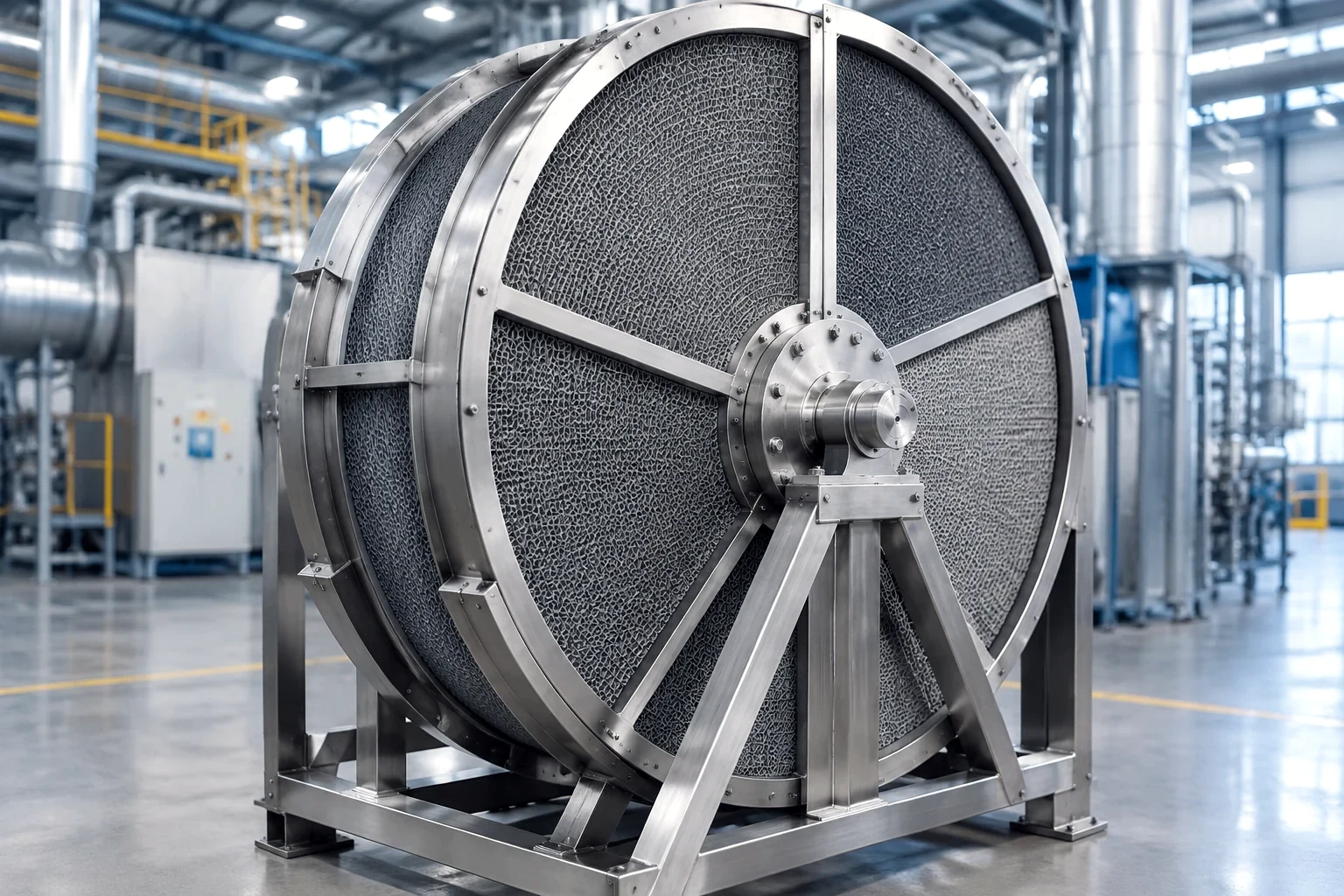
KPR (Konzentrator) is the adsorption-concentration rotor at the heart of two-stage VOC systems. The wheel is divided into three working zones — adsorption, desorption and cooling. Exhaust air passes through the honeycomb channels where hydrophobic zeolite traps VOC molecules; a small stream of hot air desorbs them into a high-concentration slipstream; the wheel then cools and rotates back to work.
Dilute exhaust passes through the adsorption sector where VOC is captured; the desorption sector receives hot air that releases a concentrated VOC stream toward the oxidizer; the cooling sector brings the media back to adsorption temperature. The result is a stable, self-regulating concentration front with minimal pressure loss.
Only the small concentrated slipstream is burned — the massive dilute stream passes through the rotor almost for free.
A 10-20× volume reduction shrinks the downstream RTO or TO by the same factor — lower capex, smaller footprint.
Rotation moves every channel through purge and desorption, minimizing fouling and downtime.
Hydrophobic zeolite captures hydrocarbons and solvent mixtures with high single-pass efficiency.
The hydrophobic molecular sieve performs reliably on the humid exhaust of waterborne paint lines.
Concentration keeps the oxidizer self-sustaining even when coating output drops.
| Parameter | Typical range |
|---|---|
| Rotor diameter | 2,000-4,500 mm, modular segmented construction |
| Adsorption media | corrugated ceramic-fibre substrate with hydrophobic zeolite coating |
| Channel structure | honeycomb monolith with parallel channels |
| Pressure drop | 300-600 Pa |
| Rotating speed | 2-6 r/h (continuous low-speed) |
| Adsorption efficiency | 90-98% single pass (hydrocarbons) |
| Concentration ratio | 8-20× (application dependent) |
| Desorption air temperature | 180-220 °C |
| Purge / cooling | integrated zones with fresh-air purge seal |
* Typical values for system selection; final parameters are confirmed against your exhaust analysis (flow, VOC species, solvent load, humidity) and target emission limits.
G4 / F7 / F9 filtration removes paint overspray and particulates ahead of the rotor.
The KPR wheel adsorbs VOC, releases clean air to the stack and produces the concentrated slipstream.
RTO / RCO destroys the concentrated VOC at 760 °C or higher with 99%+ destruction efficiency.
Hot clean gas preheats the desorption air and oven make-up, closing the energy loop.
SYZOY delivers the complete chain from filtration to stack — see VOC & Exhaust Treatment for the full system, or talk to us about a rotor retrofit for your existing oxidizer.
Spray booths and oven exhaust at high air volumes with low VOC concentrations.
Bumper, trim and parts painting lines with frequent colour changes.
Large-booth exhaust streams in furniture manufacturing.
Solvent-based printing and lamination exhausts.
Multi-solvent exhaust streams with odour control requirements.
G4/F7/F9 three-stage filtration ahead of the rotor — paint overspray and particulates otherwise clog the zeolite irreversibly.
8-20× ratio selected to match desorption airflow with downstream RTO/RCO capacity.
Hydrophobic zeolite for high-humidity and waterborne duties to keep adsorption stable long-term.
LEL monitoring, desorption temperature interlocks and bypass valve design against overheat and flashback.
Pressure drop, rotor speed and removal efficiency monitored with automatic alarms.
Annual seal and drive inspection; zeolite regeneration/replacement decided from online efficiency data.
The KPR rotor (zeolite concentrator) is the core of two-stage VOC abatement: a hydrophobic zeolite honeycomb wheel continuously adsorbs VOCs and delivers a concentrated stream at 8-20x concentration for RTO oxidation.
Typical parameters: rotor diameter 2,000-4,500 mm (modular), pressure drop 300-600 Pa, rotating speed 2-6 r/h, single-pass adsorption efficiency 90-98%, desorption air temperature 180-220°C, concentration ratio 8-20x.
Yes. Hydrophobic zeolite molecular sieve performs well with humid exhaust, making it the mainstream choice for waterborne paint line VOC concentration.
Concentration reduces the airflow entering the RTO (typically 10-20x smaller), cutting oxidation fuel consumption by over 80% and reducing oxidizer size and investment - the energy-saving backbone of paint-shop VOC treatment.
Nearly 30 coating lines delivered. Let us help you plan, build or upgrade yours.


Scan with WeChat
